Baisao, the Old Tea Seller: The Obaku Monk Who Brought Sencha to 18th-Century Kyoto
 Vytautas Butkus · Japanese culture & matcha expert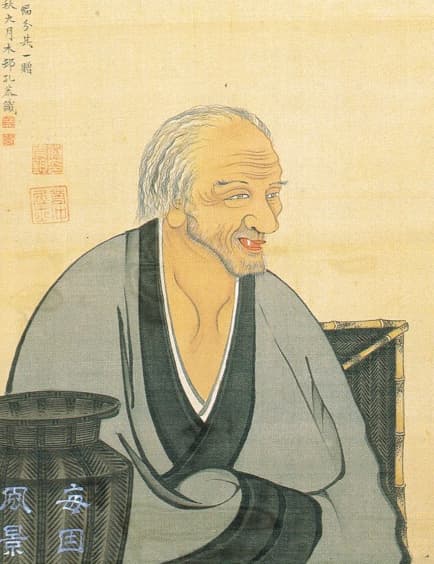
By Vytautas Butkus. Last reviewed: May 2026.
Baisao (売茶翁, 1675-1763), the "Old Tea Seller," was an Obaku Zen monk who spent the last decades of his life walking the scenic spots of Kyoto with a bamboo basket of tea things on his back, brewing sencha for whoever paid into his bamboo donation tube. His tea stalls, his poetry, and his open contempt for the formal chanoyu ceremony of his day helped move loose-leaf, steeped tea from a fringe Chinese-monastic curiosity to the favoured drink of Japan's 18th-century scholar-artists.[1]
On this page:
Who Baisao actually was
"Baisao" was not a name he was born with. It is the alias he picked up in Kyoto from selling tea, and roughly translates as "old tea seller." Through his life he carried at least four names. He was born Shibayama Kikusen in 1675 in the small town of Hasuike, in what was then Hizen province (modern Saga prefecture, on Kyushu). When he took the robes as a young Zen monk he received the priest name Gekkai Gensho. After he renounced his monastic status in 1745, at the age of seventy, he took the lay name Ko Yugai, and signed much of his late poetry that way. By then, the people of Kyoto already knew him simply as Baisao.[1]
He belonged to the Obaku school of Zen, the third and youngest of Japan's three Zen lineages. Obaku had been founded in 1654 by Ingen Ryuki, a Ming-dynasty Chinese monk who brought with him not only a Chinese style of practice but also a Chinese way of taking tea: whole leaves steeped in hot water rather than the powdered matcha that had dominated Japanese tea culture since the Muromachi period.[2]
From Ryushinji to Kyoto, 1675-1724
Baisao's father, a doctor, died when the boy was nine. By eleven he had entered Ryushinji, the local Obaku temple, where his teacher Kerin Doryo had himself studied directly under Ingen. From 1696, in his early twenties, he set out on the long pilgrimage that was expected of a serious Zen student of the period, moving between temples in Kyushu, Edo, and northern Honshu. He returned to Ryushinji as its steward, a kind of working second-in-command, and stayed in that role until 1723, when both his mother and the temple's abbot situation pushed him to leave.[1]
In 1724, aged 49, Baisao arrived in Kyoto. He carried letters of introduction from the senior Obaku priest Daicho Genko, which let him slot quickly into the city's network of monks, painters, calligraphers, and poets. He never went back to Hasuike. For the rest of his life, more than four decades, Kyoto was home.[1]
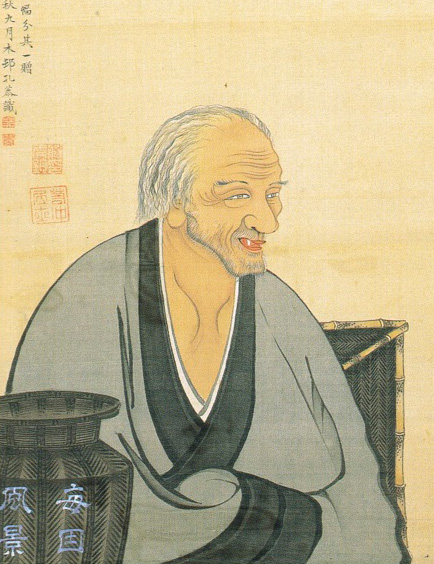
The bamboo tube and the Den of the Sages
For his first decade in Kyoto, Baisao was a fairly anonymous figure. The turn came around 1735, when he was sixty. He began carrying his tea equipment in a woven bamboo basket he had named Senka, the "Den of the Sages," and setting up portable tea stalls at the scenic spots in and around Kyoto - the cherry-blossom slopes at Higashiyama, the maple valleys near Tofukuji, the banks of the Kamo river.[1]
He never set a price. Customers dropped whatever they thought the cup was worth into a length of bamboo he had hollowed out as a donation tube. If somebody put in nothing, that was fine too. The method of preparation was simply called sencha, "simmered tea": loose leaves dropped into a kettle of just-boiled water and poured into small cups. Compared to the slow, codified choreography of the chanoyu ceremony, in which every gesture of whisking matcha had a prescribed form, this was tea stripped down to its bones.[3]
What Baisao sold was not really the tea. It was the chance to sit, briefly, in the field of a strange old monk who had clearly given up on most of what 18th-century Japanese society took seriously.
Sencha against chanoyu
Sencha as a category was not Baisao's invention. The Obaku school had brewed loose-leaf green tea in the Chinese Ming style since Ingen brought the practice with him in the 1650s, and in 1737 a tea grower in Uji named Nagatani Soen perfected a steaming-and-rolling method for needle-shaped Japanese leaves that produced what we now recognise as Japanese sencha.[4] What Baisao did was give sencha a public face and a polemic.
The polemic was straightforward. Baisao argued, in poems and in a short tract he published in 1748 as Baisanshu chafu ryaku ("A Collection of Tea Documents from the Plum Mountain"), that the formal chanoyu masters of his time had reduced tea to vanity and rank. They cared more about which utensil came from which famous kiln than about the spirit of the drink. In his reading, real tea belonged to the Chinese sage-recluses he admired - the lineage of Lu Yu, the Tang author of the Classic of Tea, and the eccentric Tang and Song poet-monks who treated tea as an aid to clear thinking rather than an instrument of status. Priests who performed the chanoyu ceremony, in Baisao's words, were "as far from the example of the ancient sages as heaven is from earth."[1]
The practical effect of the polemic was that a generation of Kyoto intellectuals started to take sencha seriously as a culturally weighty drink, not just a Chinese curiosity.[3]
The circle: Ike no Taiga, Jakuchu, Kenkado
The list of people who sought Baisao out reads like a roll-call of mid-Edo Kyoto. The painter Ike no Taiga (1723-1776), a central figure of the Nanga literati school, was a friend and admirer; so was the eccentric painter Ito Jakuchu (1716-1800), who left at least one surviving portrait of him. The Osaka pharmacist, encyclopaedist, and bibliophile Kimura Kenkado (1736-1802) became one of his closest companions in the last years of his life and went on to compile much of what is now known about Baisao's tea utensils after his death.[1]
None of this was incidental. Sencha culture, the way it took root in Japan, was not pushed by the formal tea schools - it was pushed by painters, poets, doctors, and book collectors who treated steeping tea as part of the literati way of life they had read about in Chinese sources. Baisao was the human centre of that scene.[5]
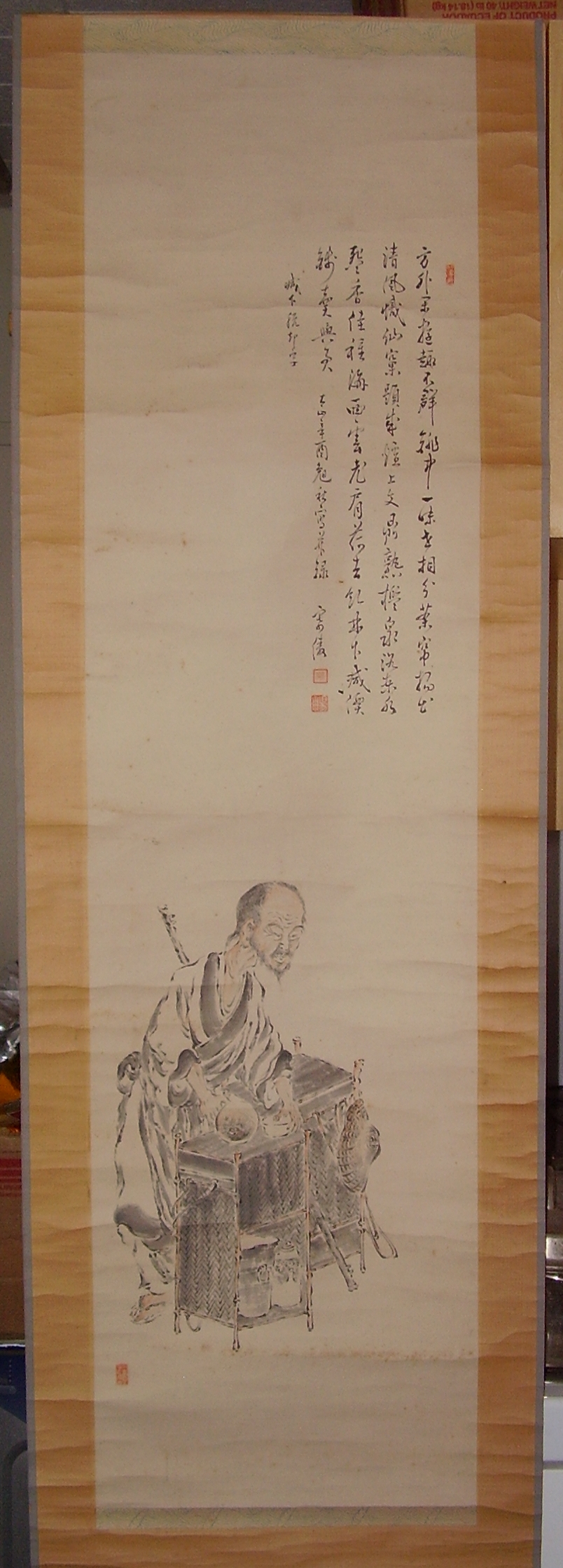
Poetry, calligraphy, and the Baisanshu chafu ryaku
Over a hundred of Baisao's poems survive, almost all in classical Chinese (kanshi) rather than Japanese verse forms. They cover his daily walks with the tea basket, his arguments with the chanoyu world, the deaths of friends, and his old age. Norman Waddell, who has translated the bulk of them into English, places Baisao alongside Basho and Ryokan as one of the indispensable Zen-inspired poets of premodern Japan, and notes that he had been unfairly neglected by Western scholarship until quite recently.[1]
His calligraphy was prized in his own lifetime. Pieces signed "Ko Yugai" still appear in Japanese museum collections, and the inscriptions he wrote on simple objects - tea cans, water jars, his own portraits painted by friends - circulated widely enough that they shaped the later visual vocabulary of senchado.
The 1748 Baisanshu chafu ryaku is his only sustained prose statement. It is part anthology of Chinese tea poetry, part apologia for sencha, and part manifesto against the social politics of chanoyu. The text was not widely read in his lifetime, but in the decades after his death it became a foundational reference for the emerging sencha schools.[5]
Burning the utensils
Baisao stopped selling tea in 1755, at the age of eighty. In the years before his death in 1763, he did something almost no other tea figure in Japanese history had done: he burned his own utensils. He set fire to a sizeable share of the tea things he had used for thirty years - kettles, ladles, the bamboo donation tube, presumably some of the Chinese-style brewing pots he favoured.[1]
The motive, in his own writings and in his friends' accounts, was preventative. He had watched, his whole life, how chanoyu utensils that had once belonged to famous masters became fetish objects, traded between daimyo households at astronomical prices and treated as relics. He did not want the same thing to happen to his own brazier and ladle. He did not want to become the founder of a school. Burning the utensils was a way of making sure no future generation could turn his tea into a ritualised lineage.
It almost worked.
The paradox of senchado
Within decades of Baisao's death, exactly what he had tried to prevent began to happen. Kimura Kenkado published a compilation of his sayings and verses, and circulated detailed drawings of every utensil he could remember - some reconstructed by craftsmen from sketches and surviving fragments. The priest Daiten Kenjo, of Shokoku-ji, wrote the earliest sustained account of Baisao's life and formalised two distinct brewing methods, identifying Baisao's style as one of the canonical lineages. By the early 19th century, the loose, anti-formal practice Baisao had spent his life arguing for had been codified into senchado, the "way of sencha," with schools, headmasters, and ranked utensils.[5]
Senchado today is a serious, living tradition in Japan, distinct from chanoyu but with its own ceremonial apparatus. Whether Baisao would have approved is doubtful. Whether senchado would exist at all without him is even more doubtful. The paradox is the point: a figure who wanted to free tea from cultural machinery ended up generating a new piece of cultural machinery in the act of resisting it.
For anyone tracing the long history of Japanese tea, Baisao sits at the hinge between two worlds - the older, matcha-centred ritualism of the Muromachi and Momoyama periods, and the broader, more democratic tea culture of sencha, hojicha and gyokuro that defines Japanese tea drinking from the 19th century onward. He is the reason the 18th century has to be discussed at all in any honest history of Japanese tea.
References
- Waddell, Norman (2009). The Old Tea Seller: Life and Zen Poetry in 18th Century Kyoto. Berkeley, CA: Counterpoint. ISBN 978-1-58243-482-7 (pbk.) / 978-1-58243-976-1. The standard English-language biography of Baisao and the most comprehensive translation of his surviving poetry and prose.
- Mair, Victor H.; Hoh, Erling (2009). The True History of Tea. London: Thames & Hudson, pp. 85-86, 108-109. ISBN 978-0-500-25146-1. On the Obaku school, Ingen Ryuki, and the Ming-style loose-leaf practice that arrived with him.
- Heiss, Mary Lou; Heiss, Robert J. (2007). The Story of Tea: A Cultural History and Drinking Guide. Berkeley, CA: Ten Speed Press, pp. 318-319. ISBN 978-1-58008-745-2. On the sencha movement in opposition to chanoyu in the Edo period.
- Waddell, Norman (2009), op. cit., pp. 50-52. On Nagatani Soen of Uji and the 1737 development of the modern Japanese sencha process.
- Graham, Patricia J. (1998). Tea of the Sages: The Art of Sencha. Honolulu: University of Hawai'i Press. ISBN 978-0-8248-2087-9. The standard English-language history of senchado and its 19th-century formalisation.
- Waddell, Norman (1984). "The Old Tea Seller: The Life and Poetry of Baisao." The Eastern Buddhist, vol. 17, no. 2, pp. 93-123. The article-length predecessor to Waddell's 2009 book.
- Pulvers, Roger (2019). Poems by Baisao. NAHOKO Press. A more recent English translation of selected poems.
- Baisao (1748). Baisanshu chafu ryaku ("A Collection of Tea Documents from the Plum Mountain"). Baisao's own prose statement on sencha.
External links
- Worldcat: The Old Tea Seller (ISBN 9781582434827).
- Open Library: Waddell, The Old Tea Seller.
- Publisher: Counterpoint Press product page.
- Google Books preview: The Old Tea Seller.
- Head temple of the Obaku school: Manpuku-ji, Uji.
- Wikipedia: Baisao, Senchado, Obaku school.
Image credits: portrait by Ito Jakuchu and the Wittig Collection caricature are both in the public domain, sourced from Wikimedia Commons.